
Trinity Parole and Probation
Parole and probation place a person in the community under different legal authority. The Texas Board of Pardons and Paroles decides parole and mandatory supervision for a person serving a TDCJ sentence. The TDCJ Parole Division then supervises an approved release. Probation, called community supervision in Texas law, comes from a court judgment and is managed by a local community supervision and corrections department. A person can leave Trinity County Jail on probation without ever entering state prison.
The judgment or release paper is the best starting point. It identifies the sentence and the agency with authority. A county roster cannot answer this question after release, and a missing name does not establish either form of supervision.
| Issue | Parole | Probation |
|---|---|---|
| Who orders it | Texas parole authorities after a TDCJ sentence | Trial court as part of the sentence |
| Who supervises | TDCJ Parole Division | 258th/411th Judicial District CSCD |
| Trinity contact | Huntsville District Parole Office | Adult Probation in Groveton |
| End record | TDCJ discharge history | Court and CSCD completion record |
- Parole
- Conditional community release while a TDCJ sentence remains active.
- Probation
- Court-ordered community supervision that may be imposed instead of confinement.
- Mandatory supervision
- A statutory release form subject to eligibility and, in many cases, Board review.
- Discharge
- The documented end of the sentence or supervision term.
Verify Trinity Post-Release Supervision
Verification requires the person’s identity, the controlling case, and the correct supervising system. Use exact identifiers when they are lawfully known. Similar names and transfers make a name-only answer weak.
- Obtain the signed Trinity County judgment or supervision order from the proper clerk.
- Read whether the sentence is community supervision, a TDCJ commitment, parole, or mandatory supervision.
- For probation, confirm the case with the CSCD county mapping and the local office.
- For parole, use TDCJ identifiers and contact the Huntsville District Parole Office or email io@tdcj.texas.gov.
- Request TDCJ public records when proof of release or later discharge is needed.
Trinity Supervision Office Split
Trinity County cases split between two offices based on the sentence. Court-ordered probation routes to the 258th and 411th Judicial District CSCD serving Polk, San Jacinto, and Trinity counties. The county directory lists Adult Probation in Groveton. TDCJ parole and mandatory-supervision cases map to the Huntsville District Parole Office in Region I. Residence approval or a special condition can result in another assignment, so confirm before travel.
126 W. 1st St.
Groveton, TX
936-642-1318
600 Interstate Highway 45 North
Huntsville, TX 77320
936-295-5217
Fax: 936-435-2603
The official TDCJ county directory shows the Trinity-to-Huntsville assignment. The captured directory image below helps identify that route.
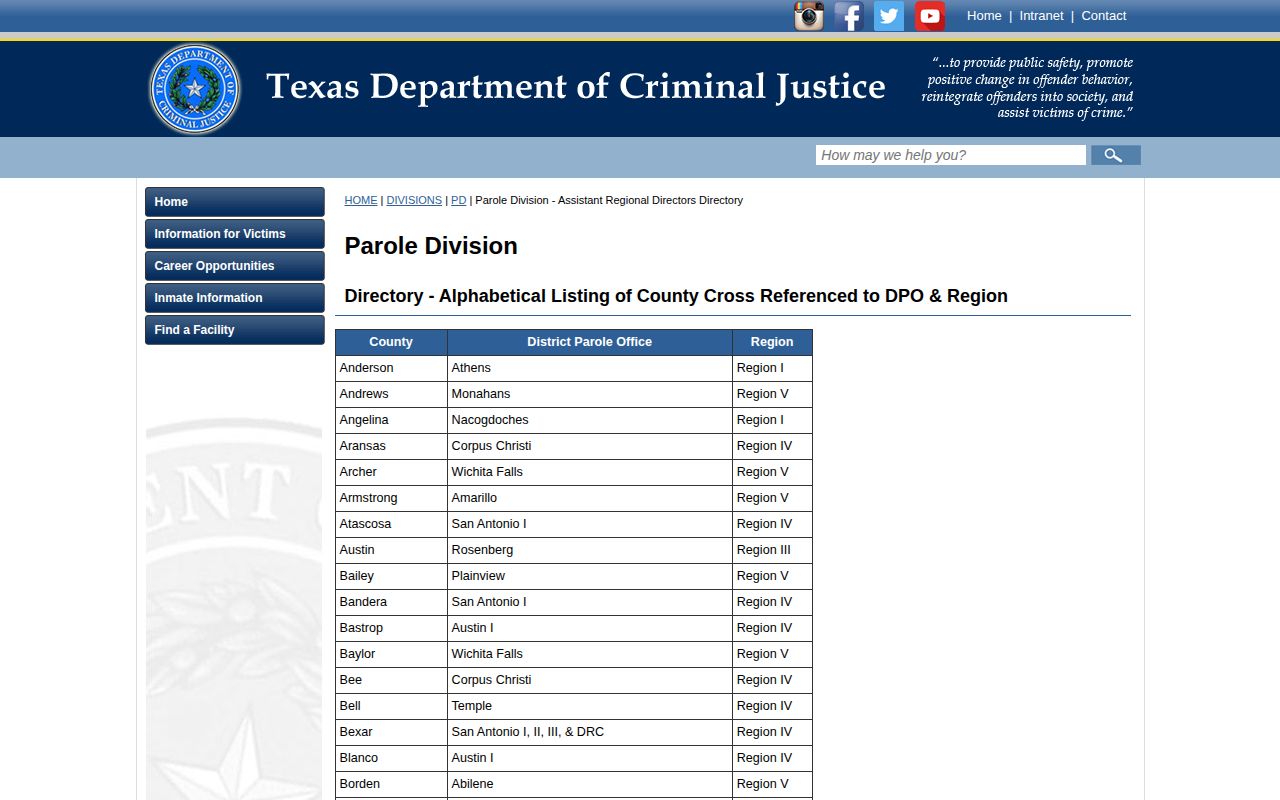
Use the mapping as a routing source, then ask the office to confirm the current assignment for the specific case.
Trinity Parole Violation Records
Conditions can include reporting, an approved residence, program participation, travel limits, and compliance with court or Board directives. The exact order controls. A claimed violation can lead to a warrant and case-specific proceedings, but it does not by itself identify where the person is held.
An absconder is someone who stopped reporting and whose location is unknown. It does not mean anyone absent from a jail roster. TDCJ operates a 24-hour tip line at 866-680-6667. The public sex-offender absconder search covers only that defined subset and must not be treated as a full parole list. County IVSS and the separate TDCJ IVSS portal may send custody or supervision events, but each notice remains informational until checked against agency records.
Trinity Supervision Discharge Records
Supervision ends through an authorized discharge, not merely through the passage of a projected date. For a probation case, obtain the court docket, signed completion or discharge entry, and the CSCD record. For parole, TDCJ’s Central File Coordination Unit updates the system after discharge. Former-supervision history is requested through the TDCJ Public Information Act route because the current inmate locator does not preserve a public released profile.
A favorable parole vote is also not physical release. Program completion, plan approval, holds, and processing may remain. The Board review sequence explains file review, while the sheriff or TDCJ release history supplies the actual custody event. The broader Trinity search and records chain appears on the released-inmate home page.
Trinity Parole Has No Calendar
Ordinary Texas parole consideration does not use a formal public hearing calendar. Board members review a file and vote in sequence. TDCJ identifies cases about six months before initial eligibility and about four months before a later review. Two matching votes make the decision. Codes such as FI-1 or a program-conditioned FI result signal approval paths; NR denies and sets another review, while SA and DMS have distinct meanings. None is a book-out timestamp.
Revocation hearings are different. They address alleged violations and may occur in a county jail. A preliminary hearing addresses probable cause, while a revocation or mitigation hearing addresses the violation and outcome. Possible results include continued supervision, sanctions, a program placement, or revocation and return to prison.
Trinity Release Expunction Notice
Since January 1, 2025, Texas Code of Criminal Procedure §55A.451 requires the person or agency effecting release or discharge to provide a written explanation of Chapter 55A expunction rights and a copy of the chapter. Someone released in Trinity County can ask the releasing office whether that paper was provided. Receipt does not mean the person qualifies for expunction. Eligibility depends on the case and statute.
A final expunction order and an order of nondisclosure have different effects. The current court order controls what can be released. Agency staff should be asked for public portions and lawful redactions, not asked to infer eligibility.
Proof of Trinity Supervision
A sound proof package links the court judgment, custody release record, supervision assignment, and later discharge. For parole, add the Board vote only as context and use TDCJ actual-release history for the event. For probation, the trial-court file and CSCD confirmation carry more weight than a prison search.
Texas IVSS-Counties is for county events, while TDCJ IVSS covers state custody and parole notifications. Neither replaces the signed judgment or agency discharge record. Note: Confirm the supervising office before visiting because residence approval and regional assignments can change.
Trinity Parole Decision Terms
Board codes describe decisions, not release. FI-1 and FI-2 are favorable paths; FI-3R and FI-4R require program work. NR denies and sets review. SA means serve all subject to applicable mandatory supervision, while DMS denies mandatory supervision. A favorable code can be withdrawn and never supplies a book-out time.
Before a vote, call 844-512-0461. After a favorable vote, call 512-406-5202 for release status. Give the TDCJ number, SID, or date of birth. For a former inmate, email pia@tdcj.texas.gov and request actual release type, supervision history, and discharge. The current TDCJ locator cannot preserve that history because it covers only people incarcerated in a TDCJ facility.
Verify Trinity Revocation Outcomes
A parole warrant or alleged violation can return a person to custody, but neither identifies the current jail. A preliminary hearing addresses probable cause. A revocation or mitigation hearing addresses the claimed violation and the response. The outcome may continue supervision, impose a sanction or program, or revoke release and return the person to prison. Ask TDCJ for case status and use the physical custodian for custody confirmation.
Probation violations remain tied to the Trinity court case and CSCD. Obtain the motion, warrant or capias, hearing order, and final disposition from the clerk. The court may continue, modify, or revoke supervision. Match any new booking number to the court action and supervising office.
Trinity Supervision Notification Channels
TDCJ IVSS covers state custody, parole, and mandatory supervision. IVSS-Counties handles participating county systems. Choose the service that matches the sentence. A county notice may concern booking or transfer, while a state notice concerns TDCJ custody or supervision. Neither is the signed order or official release history.
For active parole, TDCJ accepts inquiries at io@tdcj.texas.gov with full name and TDCJ number, SID, or date of birth. Probation confirmation goes to the CSCD and court file. This split prevents a probationer from being routed through parole records.
Trinity Probation Court Proof
For felony probation, request the judgment and later orders from the District Clerk. For a misdemeanor county case, use the County Clerk. Ask for the docket, original supervision order, any modification, revocation disposition, and final discharge. A signed order establishes what the judge directed, while the CSCD confirms the active supervising office.
re:SearchTX can help discover a file, but Texas has no single authoritative statewide trial-court search. Obtain the certified record from the Trinity clerk. A probation case should not be searched as though it were a TDCJ parole case merely because the person once appeared on the county jail roster.