
Trinity Projected Versus Actual Release
A projected date is a calculation, not proof of departure. A pretrial Trinity County detainee usually has no fixed release date because bond, dismissal, plea, trial, holds, and court orders remain unresolved. A sentenced county prisoner has a judgment and jail-credit calculation. A TDCJ prisoner may have projected, parole-eligibility, maximum-sentence, and later scheduled fields, each with a different meaning.
Find Trinity Projected Release Dates
First identify the custody type. The TDCJ inmate search covers people currently incarcerated in a TDCJ facility, not former inmates. County jail calculations come from the judgment, jail-credit record, and sheriff computation sheet.
- Confirm identity, case number, and current custodian.
- For TDCJ, search by name plus first initial, TDCJ number, or SID.
- Open the result and compare county, case, sentence, projected date, eligibility date, and maximum date.
- For county custody, request the judgment and jail calculation from the clerk and sheriff.
- Ask the agency for actual release history after the projected day passes.
The captured TDCJ search illustrates the current-custody limit.
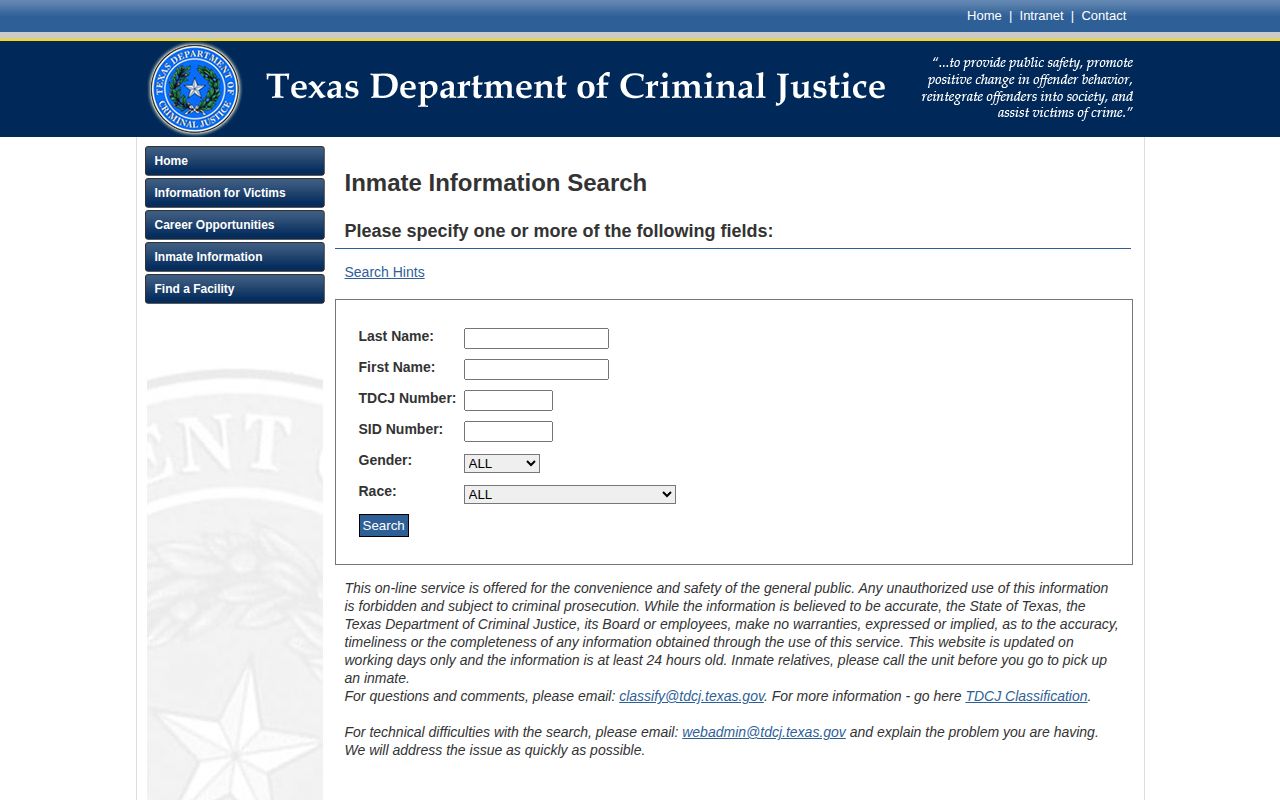
A no-result may reflect release, parole, a spelling mismatch, or custody elsewhere. Use TDCJ email or a PIA request for former-inmate history.
Texas Time Credits for Trinity Cases
Texas has no blanket 85-percent rule. Government Code §508.145 applies offense-date and offense-specific parole rules. Some serious offenses and deadly-weapon findings require one-half of the sentence or 30 calendar years, whichever is less, with a two-year minimum, before eligibility. Other cases use different calendar and good-time formulas. Eligibility only permits consideration.
Government Code §498.003 makes good-conduct time relevant to parole and mandatory-supervision eligibility but says it does not otherwise reduce the sentence. Discipline can forfeit credits. County calculations are separate: Code of Criminal Procedure article 42.03 requires credit for case confinement, while article 42.032 permits local good-conduct commutation up to one day for each day served. Trinity’s actual practice was not published, so request the computation sheet.
Why Trinity Release Dates Change
A calculation can move as sentence data and legal events change. Never arrange pickup from an online projection alone.
| Factor | Effect |
|---|---|
| Credit earned or forfeited | Changes applicable eligibility calculations |
| Sentence correction | Recalculates dates from the judgment |
| Board action | Approves, denies, or conditions a release path |
| Detainer or hold | Can produce transfer instead of community release |
| Program or plan approval | May delay processing after a favorable vote |
| New court order | Can change authority or custody destination |
Confirm Trinity Actual Release
For a county sentence, request the sheriff’s booking-out timestamp, release type, legal authority, and destination. Pair it with the signed court order. If housed off site, ask that physical custodian for its executed book-out record. For state custody, email pia@tdcj.texas.gov or use the TDCJ PIA form for incarceration history, release certificate, actual release date and type, and later supervision discharge.
Texas IVSS can provide a pending custody-change alert, but the current county and state portals are separate. The VINELink Inmate Search page explains the 2025 IVSS transition. A parole vote, projected date, or scheduled location remains planning data until the custodial record shows release.
Trinity County Jail Computation
There is no published Trinity formula, calculator, weekend-release rule, or local good-time practice. Ask for the jail computation sheet, judgment, sentence start, credited confinement, and any lawful commutation applied. Avoid importing another county’s practice.
A Trinity book-out may also name another county jail, TDCJ, USMS, or ICE. That is a transfer date from one custodian, not necessarily a community release date. Note: Confirm the destination before travel or pickup.
Read Trinity TDCJ Date Fields
TDCJ details may show parole eligibility, maximum sentence, offense, sentence date, county, case, and, once arranged, scheduled release date, type, and location.
| Date | Meaning |
|---|---|
| Eligibility | Consideration point |
| Projected | Calculated forecast |
| Maximum | Term endpoint |
| Scheduled | Processing plan |
| Actual | Historical event |
Connect the TDCJ result to Trinity by county and case number.
Texas Mandatory Supervision Dates
For eligible pre-September 1996 offenses, projected release may be the mandatory-supervision date if parole does not happen first. Later offenses use discretionary Board review. If approval does not occur, projected release may instead mean discharge.
Government Code §508.149 lists exclusions. Calendar time, good time, discipline, corrections, and Board action can change the forecast. A generic calculator cannot reproduce all case rules.
Trinity Detainers Change Release
A hold from another jail, TDCJ, USMS, or ICE can turn expected community release into transfer. An ICE detainer requests notice and up to 48 extra hours so ICE can assume custody. Follow the book-out destination.
Outside county housing is also continuing confinement. Ask which jail computes and executes release.
Request Former TDCJ Dates
Email pia@tdcj.texas.gov with name and TDCJ number, or birth data and conviction county. Ask for incarceration history, release certificate, actual date and type, and discharge. Phone 936-295-6371 or 800-535-0283 during published weekday hours.
A focused PIA request is stronger than a missing online profile. Central File updates parole files when supervision ends.
Trinity Court Date Evidence
The judgment sets sentence and credit. Ask the District Clerk for the judgment, jail-credit notation, commitment, correction, or release order. re:SearchTX aids discovery but is not authoritative statewide proof.
Pair the order with book-out. An order does not prove the person left at a certain hour. Transfer to TDCJ needs separate later release proof.
Trinity Pretrial Release Has No Forecast
A person awaiting trial has no sentence endpoint from which a projected date can be calculated. Bond may be set but not posted. A signed order may not yet be executed. Another hold may prevent community release. Ask the clerk for the order and the jail for book-out status instead of calculating from arrest.
The roster can show bond and current status when operational, yet those fields do not prove payment or release. The executed sheriff record supplies the actual event and destination.
Trinity Parole Eligibility Is Conditional
Eligibility opens review. It is not a release date. Section 508.145 uses different rules by offense, finding, and date. Some cases require calendar time without good time equal to half the sentence or 30 years, whichever is less, with a two-year minimum. Other cases use different formulas.
The Board may approve, deny, or condition release. Programming and residence plans can remain. Only TDCJ history proves physical departure.
Trinity County Credit Records
Article 42.03 requires credit for confinement in the case. Article 42.032 permits local good-conduct commutation up to one day per day served, subject to conduct. This differs from TDCJ credits.
No source established Trinity’s practice. Request the judgment, credit notation, sentence start, and computation sheet. Ask which credits were granted or forfeited. Do not apply another county’s rule.
Trinity Scheduled Release Location
A TDCJ detail may add a scheduled location after plans advance. Huntsville Unit can be a regional release site although it is in Walker County, not Trinity County. The location may change with programs, plan approval, holds, or processing.
Call before travel. For county custody, call the actual jail because Trinity uses outside housing. No official local release door, waiting area, weekend schedule, or pickup rule was found.
Trinity Release Date Evidence Chain
A strong county proof package begins with the judgment and jail computation, then adds the sheriff or physical custodian’s booking-out entry. The order explains authority. The book-out entry supplies the actual date, time, type, and destination. If the destination is another jail or TDCJ, the person remained confined.
For a state-prison path, retain the Trinity commitment and judgment, TDCJ identifying history, any Board vote, the actual TDCJ release date and type, and active supervision confirmation from the Huntsville District Parole Office. Add a discharge entry when the supervision term ends. The projected date stays contextual throughout this chain.
Trinity Sentence Recalculation Records
A corrected judgment, amended jail credit, concurrent or consecutive sentence decision, disciplinary forfeiture, or restored credit may lead to recalculation. The online field may change without explaining each component. Request the source judgment and agency calculation rather than subtracting days from a sentence.
When the public date changes, record when it was viewed and ask the custodian which official event caused the revision. Avoid treating a past screenshot as the current schedule. A recalculated forecast still does not become proof of release.
Trinity Parole Vote Timing
The Board identifies cases about six months before initial eligibility and about four months before a later review. Three voters act in sequence, and two matching votes finalize the decision. Ordinary parole consideration is not a formal public hearing with a Trinity County calendar.
Approval codes may set immediate eligibility, a future month, or a program condition. Denial codes may set another review or require service of the remaining term. A favorable vote can be withdrawn. Check release status after the vote and use actual TDCJ history once the person leaves.
Trinity Release Alert Role
Texas IVSS-Counties can notify about a local custody event, while TDCJ IVSS handles state custody and supervision. Register in the system that matches the custodian. Read whether the notice reports release or transfer, then confirm with the agency record.
An IVSS timestamp may show delivery time rather than physical departure. Preserve the alert as supporting evidence. The release certificate or booking-out record remains the primary source.
A projected field can also be blank or unknown while records are reviewed. That absence is not a promise of indefinite custody or immediate release. Ask TDCJ or the county custodian whether sentence data, a court correction, a hold, or Board processing remains pending. Keep each response dated and tied to the correct identifier. Note: Recheck the responsible agency before making travel plans because scheduled dates and locations can change.